Images of this online exhibition are the result of a project which engaged 36 Polish people in Aberdeen in partnership with the Polish Association Aberdeen and the Ice Candy School; funded by Research Data Scotland.
Researchers asked participants to build models from LEGO® bricks representing data being collected about people. This could have been anything, and participants were encouraged to use their imagination. Thereafter, they were asked to construct a character that represents a Polish person living in Scotland. This included choosing any accessories that aligned with their character (e.g., a hat, gloves, or tools representing employment or interests).
Based on these initial models, participants were asked to develop the initial LEGO® models by adding or removing bricks to show how their character would feel about: 1) reusing their data for research, 2) the impact of data research. Then, they were asked to choose a new LEGO® character representing the researcher (including any relevant accessories), adding it to the model to embody the researcher’s role and position it in the story.
The project aims to inform those working with underrepresented communities about the Polish community’s views on data research, the role of researchers, and how to involve Polish people in data research. It also provided an opportunity to enhance the Polish community’s understanding of data research, fostering new relationships and building trust with Polish organisations in Aberdeen.
The research team extends its gratitude to the participants who gave their time and shared their experiences and views on the data research with us.
Listen to the video to learn more about what data research is and the project’s background:
Stories shared by participants
Participants built 35 unique LEGO® models, each with its own story. This online exhibition presents a selection of these models with the participants’ narrative organised around issues of 1) Polish community views on reusing data for research and its impact, and 2) the role of the researchers. These photos were taken by the photographer Dorann.photography after the focus group discussion.
Polish community views on reusing data for research and its impact
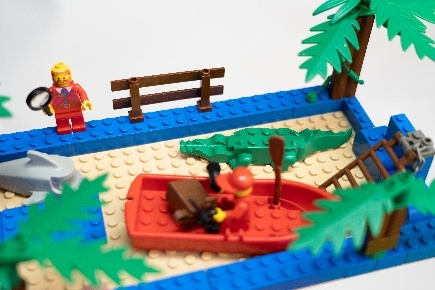
“To my island, I have added a shark and a crocodile, which symbolise dissatisfaction with reusing data without consent or in bad faith or against humanity.” (model 19)
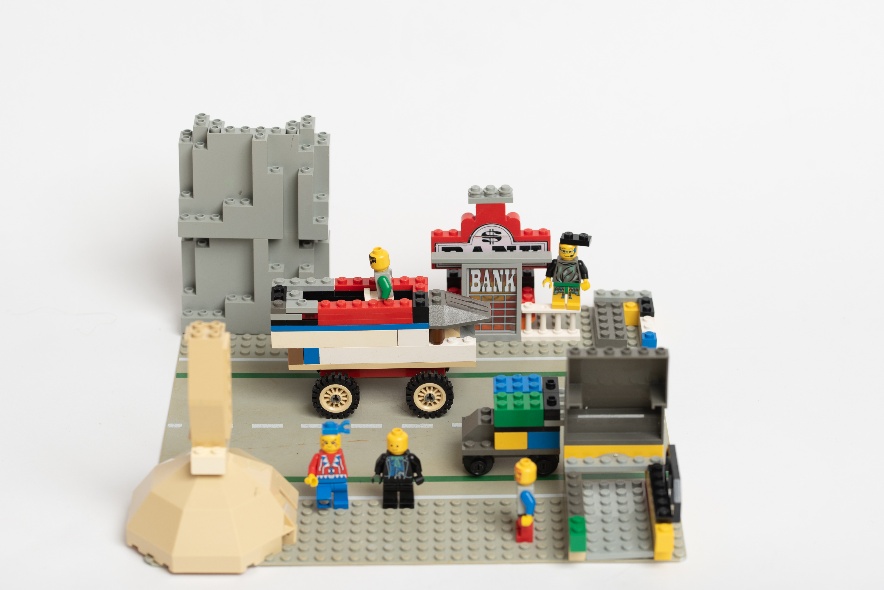
“If this information was not available, then [Polish character] would often end up in the doctor’s office, who is represented here [bottom right figure]. And here, the last, where this scientist [figure in black top and trousers] is, sharing information, which is cool. But there are problems: there is often conflicting information, information is provided incorrectly, a lot of information is generated by, a lot of information comes from places that are funded by big organisations that want specific information. So there is good information, but they are difficult to find, which makes our [Polish] character anxious.” (Model 30)
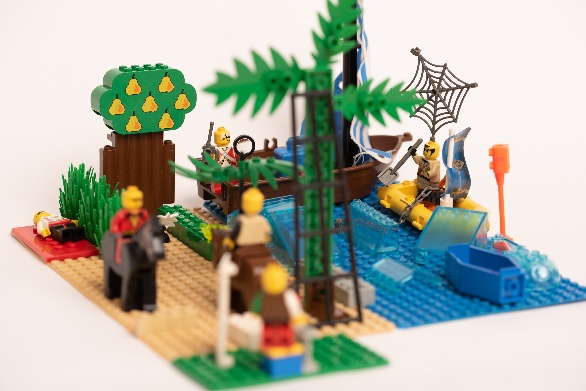
“There are many waves in my sea. There is frustration, and time passes very slowly as it [usually] happens at the sea, you don’t know when the end will be. (…) The person has had enough. He has already have a rush of thoughts [about] lack of understanding by everyone. It’s like having a spider web in his head or like generally, it is unknown what happens there. He would like to dig himself [a grave] as you can see [the character has a shovel], well, but I know, sorry, yes, it is such a helplessness, loneliness, simply giving up that’s why the little [man] isn’t sailing anywhere anymore, he is just waiting, he is drifting. No help from anywhere, I know, no help everywhere, and because of that, well, that chain, which actually is not attached to anything, but it drags behind you, behind, behind, behind me, here, it drags behind this frustrated person, and so on (…) So here is this my beloved scientist who, as you can see, can turn around; he can see everything from everywhere. Right. He gathers the news [information] from everywhere. Here I even have such [a thing] to drive, a steering wheel, so he can get everywhere. Here are open doors, which are never closed. [He is] full of understanding, so, hope is even more important. He has more opportunities because when he conducts this all research and if he will be willing to help, well, this, and he has the space, well, then this rescue will come and maybe this coffin and this chain would be gone.” (Model 16)
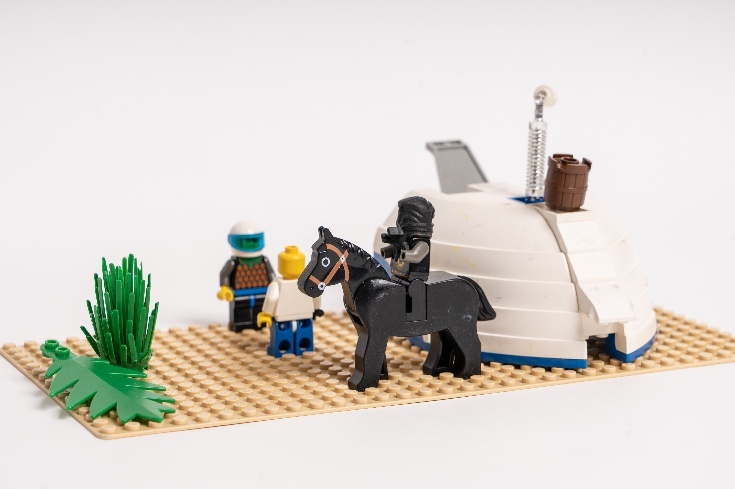
“Here I have an astronaut, who flew, let’s say, to Mars in his spaceship. And there was a data breach about this spaceship. And then a black horse rider appeared, and he [the astronaut] was scared that he [horse rider] would capture him as an alien. And a scientist comes to his rescue, and he has here a racket which he used to get there to him. Yes. He [the scientist] arrived there for him and he begins research: if indeed you can live there, if you can breathe [there], if he will indeed become an alien, if there are any threats, if he can do his research in peace.” (Model 8)
The role of the researchers
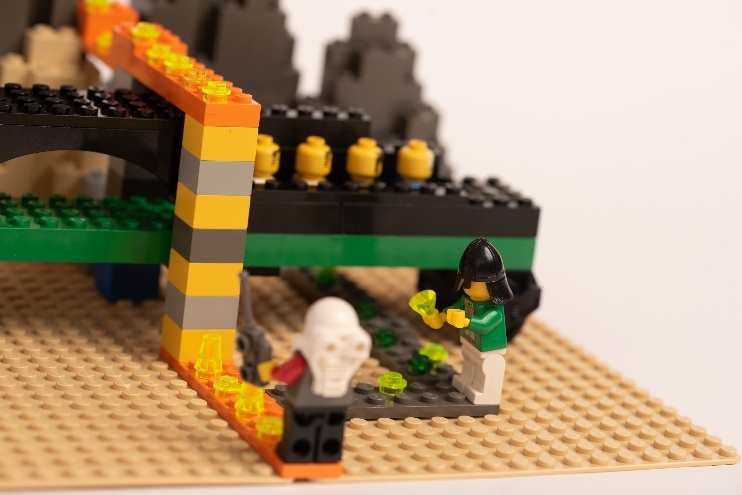
“[The scientist] carries a diamond of knowledge, and he has a hard hat, because I assume that he is able to achieve more than an ordinary citizen, especially more than an emigrant.” (model 17)
“This story starts in a garden where there was a barbecue. [Polish character] burned himself and he is taken to the hospital after 10 hours by an ambulance that finally arrived. And they are putting him on a bed. And I later added a monitor, which helps with data processing, a patient can see what is happening [on this screen]: what tests he has done. Thus, [information about] the course of those tests is available for the patient. Maybe he doesn’t necessarily understand [that information] so there is a [another] man translating what it is about. So he has a phone and is translating what is displayed on the monitor. Later, I added medical equipment, new medical equipment, which is available in the UK, but it is rarely used. But it does not help with data processing. And here sits our man [the scientist] who collects this data and looks at this screen whilst observing the patient from the other room. And that’s it. And he collects this data so that he can later hopefully help to treat others. And Pole has lost his hands because [the barbeque] exploded.” (Model 28)
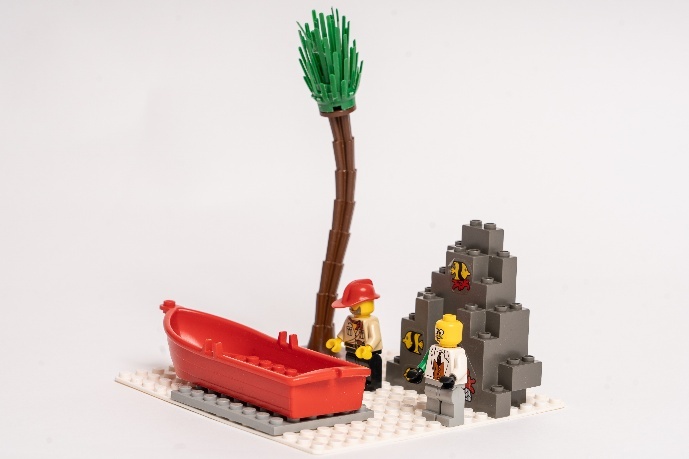
“And to those coral reefs, [Polish character] has to get by boat, and that’s all is supervised by a man in suit [the researcher], of course, how he fishes, what he catches, what types [of fish], how much [of fish]” (model 3)
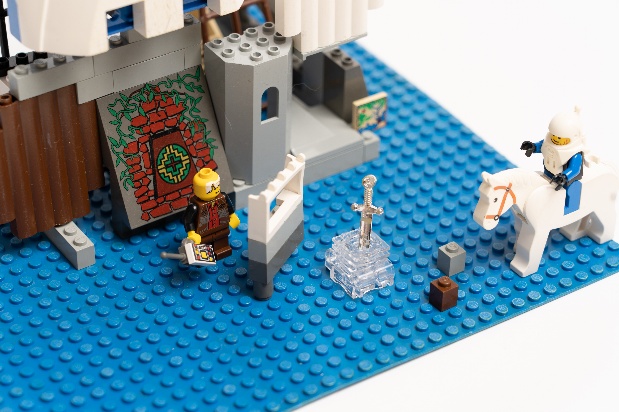
“My Pole is on a horse. He is enclosed, but he does not have weapon yet, because he firstly has to walk a rocky road. Next, there is a big stone with the Arthur’s sword, which he has to pull out from this stone to arm himself. And then he will come across the window, behind which there is a scientist, who is the ruler of the data and decides if he [the Polish character] can enter this building. So when he [the Polish character] will enter the building, and the building is some kind of, some kind of building, but actually it is a kind of a symbol of the system which doesn’t actually exist because we don’t actually know, well, it is some physical space but it is not entirely physical.” (Model 18)
Research Team
Dr Piotr Teodorowski, Research Fellow
Dr Gosia Kasprzyk, Research Assistant
Reshma Punjabi, Public Contributor
Dr Jason Adair, Lecturer in Data Science
Funding
This work is funded by Research Data Scotland (RDS). RDS connects researchers to public sector data, making it faster and simpler to access data for research. It is an independent charity, established in 2021 by the Scottish Government to help researchers generate evidence that can improve the lives of people living in Scotland.
Local partners
We would also like to thank our local partners in Aberdeen: Róza Ginter, Mateusz Łagoda from the Polish Association Aberdeen, and Klementyna Borowska from the Ice Candy School.
Would you like to learn more? Get in touch with us at piotr.teodorowski@stir.ac.uk.